In this post, I have made a list of timeless and uplifting Japanese principles and how we can practice them in our daily lives.
A country that I have always been drawn to is Japan.
Even though I haven’t visited it yet, their culture, people and ways of living are truly inspirational.
I love how Japanese wisdom, which is so deeply connected with Zen Buddhism, asks us to slow down, to appreciate, to accept, and to keep moving forward.
Many of us have only heard of a few Japanese principles, such as Ikigai, Wabi-Sabi or Kaizen, but there are also so many other beautiful and timeless Japanese principles that, if practised, can quietly transform our lives.
10 Japanese Principles to Change the Way You Live
Table of Contents
I have in no way mastered these principles, but learning about them, I can at least hope to try and live by them in small ways.
Knowing about these new Japanese principles felt uplifting, and so I thought to share it with you too.
1. Ikigai (生き甲斐) – Reason for Being
The word is made of:
- Iki (生き) — “life” or “to live”
- Gai (甲斐) — “worth,” “value,” or “benefit”
Together, it means “a reason for being” or “the thing that makes life worth living.”
Ikigai (生き甲斐) as you know is one of those Japanese concepts that gets simplified a lot online, but it’s actually much richer and more personal than the “four circles” diagram you often see.
But Ikigai is not necessarily about big achievements or career success—it can be something as grand as dedicating yourself to a cause or as simple as enjoying morning tea while watching the sunrise.
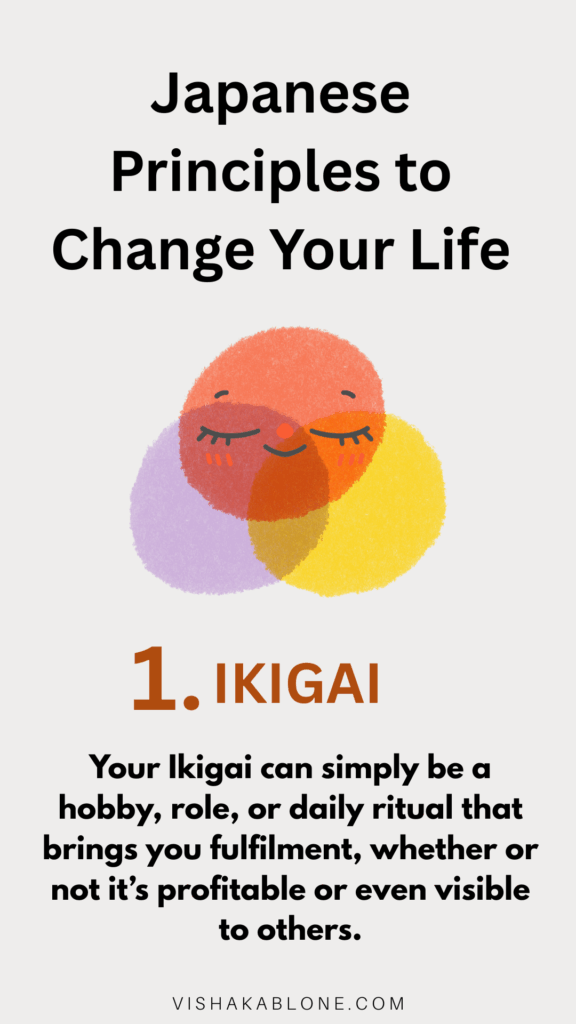
Many Western self-help books show Ikigai as the overlap between:
- What you love
- What you’re good at
- What the world needs
- What you can be paid for
This is actually more of a modern adaptation—in Japan, the concept is more personal, less career-driven, and not necessarily linked to money at all.
Your Ikigai can simply be a hobby, role, or daily ritual that brings you fulfilment, whether or not it’s profitable or even visible to others.
If you want to find your ikigai, you might ask yourself:
- What activities make me lose track of time?
- What makes me feel fulfilled even without recognition or reward?
- What kind of life would make me feel excited to wake up in the morning?
Your Ikigai can also change over time—it evolves as you do.
- P.S Hobby Ideas to live a happy life
- 100 Life Goals Ideas to create your best life
- Me-time Ideas to spend time wisely
2. Ichigo Ichie (一期一会) – “One Time, One Encounter”
Literal meaning: “One time, one meeting”
And isn’t it so true?
Not a single moment in life, no matter how monotonous we may feel life may be, is unrepeatable.
Every single moment is unique, even if it seems ordinary.
This evening I had tea with my mother and our neighbour. I bought Samosa and Jalebi to accompany with our tea.
And even though we’ve drunk tea and eaten samosas so many times, this particular evening with its laughter, stories, weather, and everything along with it will never happen in the same way.
I think this teaches us to honour every moment and pay full attention, and give gratitude towards the present moment while it happens.
To treasure the moment while we live it and not after it is done.
Ichigo Ichi is telling us, “This is the only time this will ever happen. Let me feel it fully.”
3. Shikata Ga Nai (仕方がない) – “It Cannot Be Helped”

How wonderful this phrase and principle are.
It teaches us calm acceptance of the things we cannot control.
“It cannot be helped”
Or “There’s no other way”.
It doesn’t mean giving up; rather, it is about releasing resistance and letting go.
It asks us to stop analysing and wasting our time and energy on thoughts of ‘what ifs’, “if onlys’, ‘supposed to” and ‘should haves”
Rather, it teaches us to accept what is and leave it all and surrender.
In Japanese culture, shikata ga nai has often been seen as a way to maintain dignity and composure in the face of hardship, meeting difficulties with grace instead of bitterness.
Other ways to put it:
- “It is what it is.”
- “No use fighting what cannot be changed.”
- “Whatever happens is the only thing that could have happened”
- “Breathe, accept, and move forward.”
- “Some tides can only be ridden, not turned.”
Here are some affirmations that could go along with it:
- I release what I cannot control.
- I meet life as it is, with grace.
- Some things are beyond me, and that’s okay.
- I choose peace over resistance.
- What is, is enough for now.
- I bend, but I do not break.
- I accept the unchangeable and focus on what I can do.
- I walk forward lightly, leaving behind what I cannot carry.
- Every ending is simply a turn in the path.
- The tide moves on, and so do I.
- I accept what is. I respond with strength and dignity.
- P.S Positive Affirmations to Say Daily
- On heartbreak, Love and Surrender
- On Heart Opening and Intentional Suffering
4. Nanakorobi Yaoki (七転び八起き) – “Fall Seven Times, Stand Up Eight”

Life is never about not making any mistakes or not ever failing.
If we ever do research on people’s failures or mistakes, you won’t ever find a single person who has not failed in something or the other.
If we are born, failing, mistakes and suffering come along with it. They are non-negotiable in our lives.
So it’s not about avoiding failure and always trying to play it safe.
We didn’t come here to play it safe.
We didn’t come here to always be protected.
We came here because we were chosen to come here.
We came here to learn resilience.
We came here to touch suffering and then transform it.
We came here to break our hearts and then evolve from it.
So it really doesn’t matter how many times you’ve failed. Stand up just one more time than the number of times you’ve fallen.
5. Zanshin (残心) – Mindfulness in Action

Have you ever realised how we finish a task?
Usually, even before we finish a task, we feel eager to finish it so that we can move on to the next.
When you are washing the dishes, you wash them hurriedly so that you can go back to watching that Netflix series.
When we are eating something, we usually don’t even give a care to what we are eating as we scroll our phone or talk with someone.
Many times we don’t even realise that our food is already over until we find ourselves thinking how it really tasted, and so you end up serving it another time.
We move on recklessly from one task to the next.
But if we only practised Zanshin and carried this principle throughout our life, we would be much more aware, intentional and relaxed in our entire disposition and how we lived our day-to-day life.
In Japanese philosophy and martial arts, Zanshin means the state of relaxed, alert awareness and presence that remains even after an action is complete.
In daily life, Zanshin could be practised in such ways:
- Not being eager to finish off a task, but being with them fully and letting it be done slowly without rushing
- Not moving from one task to another, but allowing space between things.
- When you wake up in the morning, you don’t simply open your phone first thing, but be mindful of your breath and get up and walk gently from room to room and finish each chore mindfully and spaciously.
- After you finish your morning coffee, you sit for another moment to savour a me-time moment before your day begins.
- After finishing an exercise or yoga, not simply getting up and using your phone, but allowing yourself to cool down and say thank you to your body.
- While walking, you reach your destination, but instead of pulling out your phone right away, you remain aware of the street, the air, and the people around you.
- In conversations, after someone speaks, you don’t immediately jump in; you remain present and try to respond.
- After bowing in prayer or meditation, you don’t just “snap back” into your day, but carry the calm focus with you for the next moments.
Zanshin is like a gentle afterglow of awareness and mindfulness that acts like an anchor to the present moment.
6. Kaizen (改善) – Continuous Improvement
- Kai (改) – change, modify, make better
- Zen (善) – good, virtuous
So it means “change for the better” or “continuous good improvement.”
Kaizen is about small, consistent steps that accumulate into big changes over time.
This means that you don’t have to be extreme, just consistent.
You don’t have to make great leaps of change all of a sudden, but simply focus on tiny improvements every day.
It’s rooted in the belief that even a 1% change, sustained over weeks and months, can transform your life.
Whenever you get consumed by thoughts of things not being perfect, not being great at something already, remind yourself that you allow yourself to get better slowly but surely.
It’s the idea of progress over perfection.
7. Oubaitori (桜梅桃李) – Don’t Compare Yourself
- Sakura (桜) – Cherry blossom
- Ume (梅) – Plum blossom
- Momo (桃) – Peach blossom
- Uri (李) – Apricot blossom
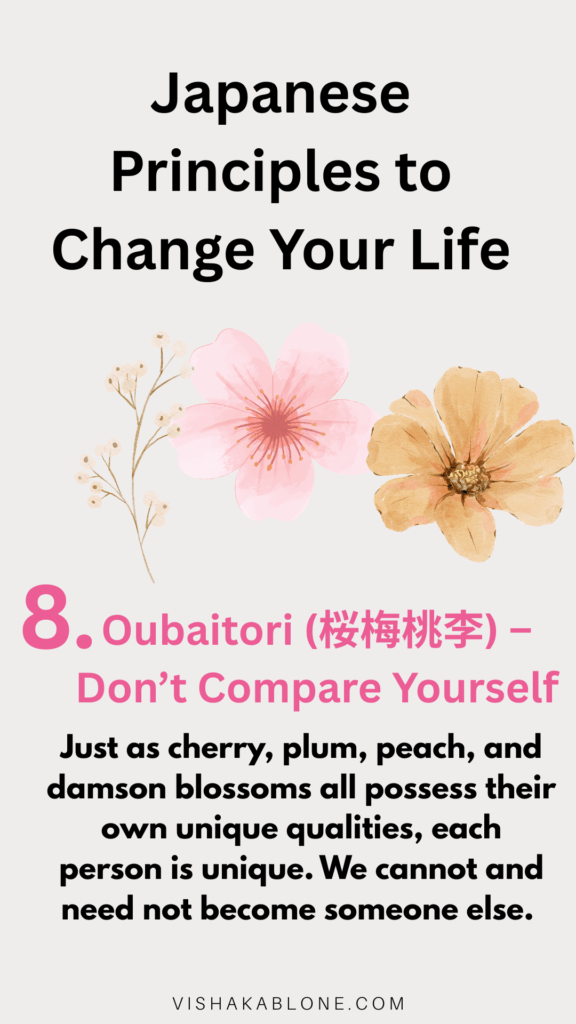
You could say that this principle deeply changed how I started to live my life and see myself.
I am an introvert by nature.
I used to be very timid and insecure, especially when dealing with people.
I would rather not let anyone see me than face people and talk to them.
There was an inherent inferiority complex which made me feel that I was not good enough.
I would feel people would make fun of me, judge me or talk about me, whether it be about my weight, how I dressed up, how I talked or even how I simply behaved.
This made me feel underconfident throughout my childhood and even through my teenage and early 20s until I came across this concept of cherry, plum, peach for the first time from my Japanese mentor.
Reading my mentor’s lines gave me a great sense of relief. He says,
Just as cherry, plum, peach, and damson blossoms all possess their own unique qualities, each person is unique. We cannot become someone else. The important thing is that we live true to ourselves and cause the great flower of our lives to blossom
-Daisaku Ikeda
And this is exactly what Oubaitori means.
It stems from the idea that each tree blooms in its season, with its unique colours, shapes, and fragrance.
Just as you wouldn’t expect a plum tree to bloom like a cherry tree, you shouldn’t force yourself to follow someone else’s timeline.
Trees don’t compare or compete with each other. They just are.
You, too, can just be.
This cherry, plum, peach and damson principle allowed me to give myself a chance to just be myself and not let myself shrink or feel inferior, or even superior towards anyone.
Instead, I must be my truest self, and in being my truest self, I am my most confident, loving, joyful and unique self.
Also, I must honour my own timeline and not rush with society’s timeline of success, marriage, family or anything, and simply walk my path.
8. Wabi-Sabi (侘寂) – Beauty in Imperfection
Wabi-Sabi celebrates the imperfect, impermanent, and incomplete as natural and beautiful.“Nothing lasts, nothing is finished, and nothing is perfect — and that’s okay.”
Wabi Sabi could mean:
- Finding beauty on a weathered wooden table, scratched but warm from years of shared meals.
- A faded photograph that carries a story.
- Loving our loved one fully through all their flaws and weirdness.
- Enjoying the flowers in your flower vase while it lasts
- Repairing broken things with love
- Accepting sun spots, fine lines and ageing gracefully
- Keeping A handwritten note from years ago
- Accepting life as it is rather than obsessing/worrying about how it should be
- Autumn leaves just before they fall
It is a practice of letting go of perfectionism, accepting the impermanent, incomplete nature of things
9. Omoiyari (思いやり) – Compassionate Consideration
As human beings, we all intrinsically have a desire to be good, to leave this Earth having done something worthwhile, to touch the hearts of many and live a life that is of help to other human beings at least in some way.
Do you have this urge in you, too?
I am so sure that you do.
It doesn’t take a lot to touch the heart of another person.
What we wish for ourselves is what others also wish for themselves.
How we wish to be treated is how others also wish to be treated.
And don’t we wish to be treated thoughtfully? Considerately? Sincerely?
It is the same for others, too.
It doesn’t take much to leave a mark on the heart of someone.
Sincerity and compassionate consideration pierces the heart of people and even the Universe/God because He is always watching.
People might forget your words and even your actions, but they will never forget how you made them feel touched, understood and appreciated.
And this is what it means by Omoiyari- Compassionate consideration.
It is the act of doing things for someone without them asking for it.
Here are other ways to practice Omoiyari in Everyday life:
- Saving a seat for a friend
- Being of help to your mother or spouse without them asking for it
- Bringing some snacks in the evening for your roommate as well
- Apologising and saying sorry first
- Lowering your phone’s volume if someone is sleeping or studying
- Offering to carry your mother’s shopping bag
- Being punctual so others don’t have to wait
- Checking in on a friend if you haven’t heard from them for a while
- Offering a seat to an elderly
- Supporting your friend by sharing their work without them asking for it.
- Congratulating someone for their little progress and wins, and not just for big reasons such as weddings or engagements.
- Bringing a little more food to the tiffin to offer someone
- Validating feelings instead of rushing to give solutions — “That sounds really hard. I can see why you’d feel that way.”
These are just some of the ways we can show up considerately for others.
Compassion and kindness are also growing virtues. It is not fixed, and we can be better and better at it each time we practice it.
10. Seijaku (静寂) – Tranquility in the Midst of Chaos

Seijaku means cultivating intentional stillness and silence, even if for just 5 minutes a day.
It is the calm you cultivate within, especially during hectic times.
Practising this Japanese principle means refusing to give in to hurriedness and urgency.
In Daily life, it would mean starting your mornings unhurriedly and silently rather than going straight in your phone and bombarding yourself with reels, stories and noise.
Here are other ways to practice seijaku in everyday life:
- Pausing to sip tea slowly before starting work.
- Cooling down after a workout and meditating before folding your yoga mat.
- Taking a mindful walk without headphones, just listening to natural sounds.
- Creating a “still corner” in your home with minimal objects, candles, aroma and using that space to meditate and be still.
- Sitting quietly with someone you love, without feeling the need to fill the silence.
Final Thoughts on Living These Japanese Principles

In the end, these Japanese principles are something reserved only for monks or artists.
They can be practised by anyone of us regardless of where we are from, who we are or what we do for a living.
They are gentle reminders to live more mindfully, gracefully and wholeheartedly accepting life’s inevitable storms as well as giving care to each small action.
No small act is truly small. They all carry their ripples through our day.
May we live our lives gently and pay attention to the little things, being as grateful and graceful as we can.
You might also like:







Leave a Reply