Digital discipline seems like a new word, but now, more than ever, we need discipline in this area of our life.
We live in a time when screens are everywhere—on our desks, in our hands, even on our wrists.
Our phones are the first thing we reach for in the morning and the last thing we put down at night.
Technology has made life easier, but it has also made us forget how to focus, how to truly rest, and be present.
Recently, I’ve been trying to be a little more disciplined with my phone habits, and I can feel how much this small shift improves my mood, focus, and energy levels.
Just like you don’t notice the noise playing in the background until it suddenly stops and you become aware of the silence, you don’t realise how scattered your attention and energy are until you practice a bit of discipline and experience the difference.
That’s what I’ve been noticing lately.
No wonder I’ve written and shared more on my blog in this one month than I did in the entire past year.
I have been able to give more time to my reading and writing and other stuffs that matter, and it feels good to be back.
And so I felt inspired to write this post on Digital Discipline and how to practice it.
But, first of all..
You are not alone
Table of Contents
If you’ve ever found yourself picking up your phone without knowing why, or scrolling endlessly when you meant to do something else, you’re not alone.
We are constantly online and bombarded with notifications after notifications screaming for our attention.
Just “five minutes online” often turns into hours, and 1-minute reels and short videos turn into hours of doomscrolling.
So discipline now would mean to be disciplined with our phone habits and use it more mindfully, rather than letting it use us.
The reason it’s so hard to leave the platform is that there are people who are paid to keep us there.
It is designed to keep us hooked.
Even though social media and most technology are free, it is getting too expensive.
It is costing us not only our energy, our mental peace but our dreams about what we really want to do.
Our attention span has gone down the drain.
Our digital distractions sabotage our capacity to want what we want to want, and we know about this very well.
So here is where digital discipline comes in, and now more than ever, we must practice it.
What is Digital Discipline?
Digital Discipline is being mindful of our digital life and using technology with intention.
Digital discipline is not about cutting yourself off from the online world and deleting all the apps, but learning to control your digital habits.
It is learning how to use your phone, your iPad, your computer mindfully instead of letting them use you.
This could be self-mastery in this digital age.
The result is that slowly you will be much more in charge of your life instead of aimlessly drifting where the world inside your phone takes you.
Why Digital Discipline Matters
1. To be happier and freer: Digital discipline will improve your mental wellbeing where too much screen time leads to stress, comparison and information overload.
You don’t need any more information.
You need calm and stillness. You won’t miss out on anything by practising digital discipline.
2. To Protect your Focus: Stop splitting your attention to a hundred things online.
No wonder you feel you are stretched too thin and cannot concentrate on anything.
Digital discipline helps you set boundaries so you can give your best energy to what truly matters.
3. To be aligned with your goals: Digital distraction has turned us all into mere consumers.
But we were born to create, to live, to learn and to go after the dreams in our hearts.
Digital discipline will help you come back to what truly matters to you.
When you stop reaching out for your phone after every 5 minutes, you will be forced to find other things to do that are actually meaningful for you.
4. To Strengthen Relationships: When you’re less glued to your phone, you’re more present with people around you. This leads to deeper conversations and stronger connections.
5. To create Balance: Technology is powerful, but without limits, it consumes our entire day.
Discipline will help you enjoy both the online world and the offline world.
Digital discipline is not about restriction.
It’s about freedom- freedom to choose when and how you use your phone and devices; freedom to gain back time, clarity and peace of mind.
It’s a gentle practice of reminding yourself: I am in control of my devices. My devices are not in control of me.
With small daily habits, digital discipline can transform the way you live, work, and connect with yourself and with others.
How to Practice Digital Discipline
Here are practical ways to bring digital discipline into your everyday life:
1. Start your mornings screen-free
If you check your phone first thing in the morning and immediately step into social media and check your notifications, then simply deciding to stop this habit will be life-changing.
Decide to spend the first 30–60 minutes of your day without your phone.
Start a morning routine instead.
Use this time to journal, meditate, stretch, or simply enjoy a quiet breakfast.
P.S How to start journaling- a beginners guide
2. Check Essentials Only
After your morning routine, when you do reach for your phone, check only important messages/emails, not social media.
Skip the unnecessary apps, social feeds, and random notifications that can easily pull you into distraction.
These days, I don’t log into social media until around 12-1 pm.
When I do this, I have noticed that I save so much mental energy, feel much calmer, and my focus remains better in the day for meaningful work and be more present in the real world
Try these two first for the next few days and see if you feel any difference.
3. Park your phone
This is a super-effective digital discipline trick.
It basically means to keep your phone in a fixed spot (like a drawer, another room, or a charging station) to spend your time more intentionally and to stop being distracted.
Here’s how you can use it:
- When working/studying → park your phone in another room.
- When eating → park it away from the table.
- Before bed → park it outside the bedroom so you don’t reach for it.
- During self-care/meditation → park it so you stay present.
4. Use a Dummy Phone with No Internet Access
I recently read that now millennials and Gen Zs are using a dummy phone more than ever to reduce anxiety, overstimulation, and constant brain overwhelm.
I, too, have bought one, and that’s where my main phone number is.
This dummy phone is just for phone calls and nothing else. And it does its job well.
This way, I can park my smartphone for most of the day.
For my smartphone, I’ve bought a new phone number that only a few close people know.
Using a dummy phone gives you the security of being reachable without the constant pull of social media, emails, or notifications.
Many people use a dummy phone during work hours, vacations, or digital detox days to reclaim focus and peace of mind.

5. Turn Off Non-Essential Notifications
Turn off notifications of Social media, shopping apps, and random news alerts.
Yes, you may disable them completely.
You don’t have to know any notifications for those apps.
6. Delete the apps
Identify the Triggers. Notice which apps you open mindlessly.
We’re so used to using our phones that opening up certain apps like Instagram or other shopping apps has become like second nature.
Our hands automatically go reaching for those apps out of habit, even though we may have nothing to do.
So yes, delete the most distracting ones.
You will miss out on nothing.
Replace with healthier alternatives such as reading, journaling, and podcasts.
Or you could also invest in buying a Kindle. (Here are 7 reasons why you should Buy a Kindle)
But, if you’re not ready to delete, at least log out so opening them feels like an effort.
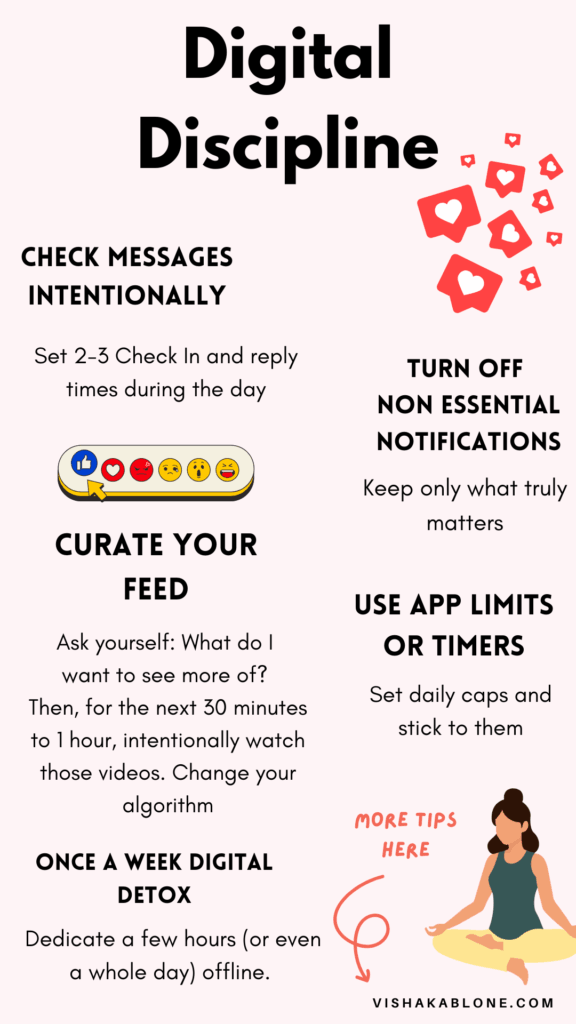
7. Curate your feed
Curating your feed on social media and YouTube makes a huge difference.
Ask yourself: What do I want to see more of?
Then, for the next 30 minutes to 1 hour, intentionally watch those videos.
If your YouTube is filled with catchy titles, taglines, and celebrity gossip that tries to pull you in, make a conscious choice to open the kind of videos you now want to watch.
I tried this once when I noticed YouTube was distracting me with gossip and clickbait.
Instead, I opened meditation music, financial advice, and good music videos — and slowly, YouTube caught on.
My algorithm started changing to show me exactly what I wanted.
You can do the same for Instagram and TikTok, too.
Once you train the algorithm, it will begin showing you more of what truly adds value to your life.
8. Use Web Instead of Apps
If you still need occasional access, only use the browser version.
Going with the web version instead of the app is a smart move when you’re trying to cultivate digital discipline.
It’s slower and hence makes it less tempting.
Using apps in the web browser, you become more intentional with the usage and you’re less likely to get pulled into distraction.
That extra effort of logging in each time discourages mindless checking and promotes conscious, purposeful visits.
I use Instagram this way when I am not planning to post anything.
Thus, I don’t end up watching reels after reels for no reason and am using it far lesser.

9. Set Work Blocks
Work in focused 50–60 min blocks with a 5–10 min break.
Decide before starting what you’ll do in the block.
Then park your phone somewhere away from your desk in your drawer or in another room.
Keep your phone on silent.
This stops multitasking, which is switching between WhatsApp, email, and Instagram.
You can use a timer to mark a clear start and end.
This will keep you accountable, and you will be much less tempted to use your phone in the middle.
Certain apps help you do this, such as the Forest app.
Whenever you want to stay focused, plant a tree there.
In the 5–10 minute break, stretch, drink water, breathe, maybe look outside.
Again, avoid checking social media during break time as it stimulates the brain too much and ruins the flow.
10. When using your phone, only use your phone
As Thich Nhat Hanh says, “While Walking Walk, While Eating eat”
In the same way, while using your phone, only use your phone.
This is a solid digital discipline tip.
Don’t scroll while eating, watching TV, or working.
Give it your full attention, finish what you need to do, and then put it away.
This way your phone doesn’t leak into every part of your life.
11. Mindful Check-In
Allow yourself a 15–30 minute slot to check social media or leisure apps consciously.
Using social media for less than 1 hour per day is the recommended ideal by mental health experts to balance staying connected without getting drained
A study from the University of Pennsylvania found that limiting social media use to 30 minutes daily significantly reduced anxiety, depression, loneliness, and sleep problems.
Set a timer if needed.
A mindful check-in is a simple pause before reaching for your phone.
Each time you unlock it, ask yourself, “Why am I opening my phone right now?” and name your intention — whether it’s to reply to a message, check the time, or complete a task.
Notice your mood in that moment- are you bored, anxious, or just avoiding something?
Most of the time, it is just our urges to avoid something that we have to do, or even want to do that we end up checking our phone.
This small habit helps you use your phone consciously, instead of on autopilot.
12. Scheduled check-ins
Scheduled check-ins mean deciding in advance when you’ll look at your phone or social media, instead of constantly checking throughout the day.
For example, you might set three slots- once in the morning, once in the afternoon, and once in the evening- to catch up on messages, emails, or updates.
You don’t have to reply to messages instantly.
Outside these times, you can park your phone and keep your notifications turned off.
This creates structure, reduces anxiety about “missing out,” and gives you long stretches of uninterrupted focus.
By checking on your own terms, you stay in control of your digital use instead of letting it control you.
13. Mindful social media
This is a big one, and we’re all guilty of not using social media mindfully and being overtaken by doomscrolling.
But if only we are able to do this mindfully, then most of our distractions and problems would vanish.
Come out of the autopilot use of social media.
Here are some ways to be mindful of social media use:
- Before opening the app (browser recommended), pause and ask yourself why you are logging in— is it to connect with a friend, share something, or learn?
Yes, you can always use social media just for leisure and with no purpose too. If that is so, simply be aware of that too.
- When you’re starting to build digital discipline, set a time limit for how long you’ll stay, and notice how the content you consume makes you feel.
These days, I am downloading the Instagram app when I want to post a story or post, and after it’s posted, I again uninstall the app and use it from a browser instead.
- Follow accounts that inspire, educate, or bring joy
- Unfollow or mute anything that drains your energy or triggers negativity.
- Once your purpose is complete, log out or uninstall the app instead of lingering.
Use social media for the reason it was created- a tool for connection and growth rather than a source of distraction.
14. Screen-free meals
Screen-free meals mean putting away not just your phone, but all screens — TV, laptop, or tablet while you eat.
This one is a bit hard to practice because I, too, am in the habit of watching something while I eat alone.
But when I am with someone, I always put down all screens and enjoy the food and conversations.
But I’ve heard so many great things about eating food mindfully and screen-free, even when alone.
They say it helps you slow down, savour your food, and truly appreciate the food you are eating.
15. Set Screen Free hours
Setting screen-free hours is like giving your mind a reset each day.
Choose a fixed time each day where you don’t use any screens at all.
The ideal is to be screen-free free the first hour after waking up or the last hour before sleeping
I do this, and this boundary has helped me save so much energy and given me mental peace.
I now have time to do my morning routine properly and end my day winding down with satisfaction and ease.
Not being glued to the screen in the morning lets me do my morning routine properly, and at night lets me wind down with ease.
I now follow a good nighttime skin care routine, read a few poems or short stories before sleeping, and it helps me truly enjoy resting.
16. Follow a digital Sunset
A digital sunset is simply deciding when your screen time ends for the day, just like the sun setting in the sky.
Pick a time in the evening, maybe an hour or two before bed, when you intentionally switch off from phones, laptops, and TV.
This helps your mind slow down, your eyes relax, and your body prepare for restful sleep.
Instead of scrolling late at night, you can use this time to journal, read, stretch, or have a quiet conversation.
Over time, this ritual becomes a signal to your brain that the day is done, helping you rest well, sleep well and wake up lighter.
17. Set phone-free zones
Creating phone-free zones is a simple but powerful way to practice digital discipline.
Decide on certain spaces, like your dining table, bedroom, study desk, or even your prayer/meditation corner, where phones aren’t allowed.
These spaces then become reminders of presence, rest, and focus.
For example, keeping your bed phone-free stops you from lying down and scrolling endlessly.
18. Practice weekly digital detoxes
Dedicate a few hours (or even a whole day) offline.
Choose one day in a week when you do this and step away from unnecessary screens.
Put your phone on silent, log out of social media, park your phone somewhere and give yourself permission to be offline.
Use this time to go for a walk, read, write, spend time with loved ones, or simply rest without digital noise.
You can try it this week and notice how you feel.
These can be your own mini retreat at home that helps you regain clarity, restore focus, and remind you that life exists beautifully beyond the screen.
19. Declutter Your Home Screen
Keep your phone neat and organised.
Keep only the apps you actually use daily and move distracting apps to hidden folders.
P.S How to declutter and organize your phone
20. One Week Detox
Try living 7 days without the deleted apps. You’ll see you don’t “need” most of them.
At first, it might feel strange, and you might keep reaching for your phone out of habit.
But slowly, the quiet will start to feel good.
You notice the little things: the way your mornings feel calmer, how meals taste better when you’re fully present, or how conversations go deeper without a phone on the table.
During this week, you can fill your time with reading, journaling, exercising, meditating, or simply resting.
It’s not about cutting yourself off from the world, but about giving yourself a chance to return to it refreshed, with more focus, presence, and intention.
21. Digital sabbath with loved ones
A digital sabbath with loved ones is about setting aside a day or even just a few hours where everyone agrees to put their phones and gadgets away.
No constant notifications, no distractions, just being present together.
It could be a Sunday lunch, a family outing, or a quiet evening at home.
During this time, enjoy a meal, game, or walk together, or simply have tea and enjoy screen-free conversations.
I didn’t know that at home our tea time is kind of like a digital sabbath every evening.
- P.S Ichigo Ichie and other stories from the week
- Quiet Acts of Grace
- Ordinary Things that Aren’t Ordinary at all
Final Thoughts on Building Digital Discipline

Our attention is one of our most valuable resources.
We must remember what we are paying attention to.
As Mary Oliver says, “Attention is the beginning of devotion”
Digital discipline isn’t about rejecting technology, but about giving a little awareness to using it with the intention that it serves us, instead of controlling us.
Discipline is what sets us free. It is what makes us want what we want to want.
Otherwise, without discipline, we get thrown away like a monkey being distracted by every banana.
You need not do all of these practices. I, for myself, might not be able to practice all.
I practice a few of them and honestly, even this makes such a difference in how I use my time, how I feel and how my energy levels are.
We can all start somewhere and practice even one for a few from this list and start today — maybe a screen-free meal, a digital sunset, or simply parking your phone for an hour.
You might also like:
- 3 Unknown Tricks to Build Self-Discipline
- 50+ Hobby Ideas for adults to enjoy
- Helpful ways to reduce screen time
- How to figure out what to do with life






Leave a Reply