I am writing sitting in a train today from my phone.
I had gone for a short trip to Bodhgaya with my family. Bodhgaya is the place where the Buddha attained enlightenment over 2000 years ago.
The tree under which he gained enlightenment still stands. Though it cannot be said that it is the same tree, it is a descendant of the original tree, in that it is grown from its cuttings, replanted again and born again.
It symbolises continuity: sameness and yet difference, and in many ways, it quietly feels like a reflection for us humans too. (On Lessons from Plants and the Gift of Paying attention)
This might have been my 4th visit to Bodhgaya. The last time was exactly 10 years ago, in December of 2015. Back then, too, I had come with my family, but while they returned, I had stayed back for ten more days to do my first Vipassana meditation at Dhamma Bodhi. That experience altered my life in many ways.
Coming back after 10 years, I noticed that nothing much had changed, other than the number of people. The crowds were immense.
As we all know, India is known for its population, but even as someone born and living here, the sight of so many people everywhere is something I still struggle with. And Bodhgaya, being in Bihar, a state that remains among the least developed in many aspects, I felt that it looked much the same as it did ten years ago, perhaps even more chaotic.
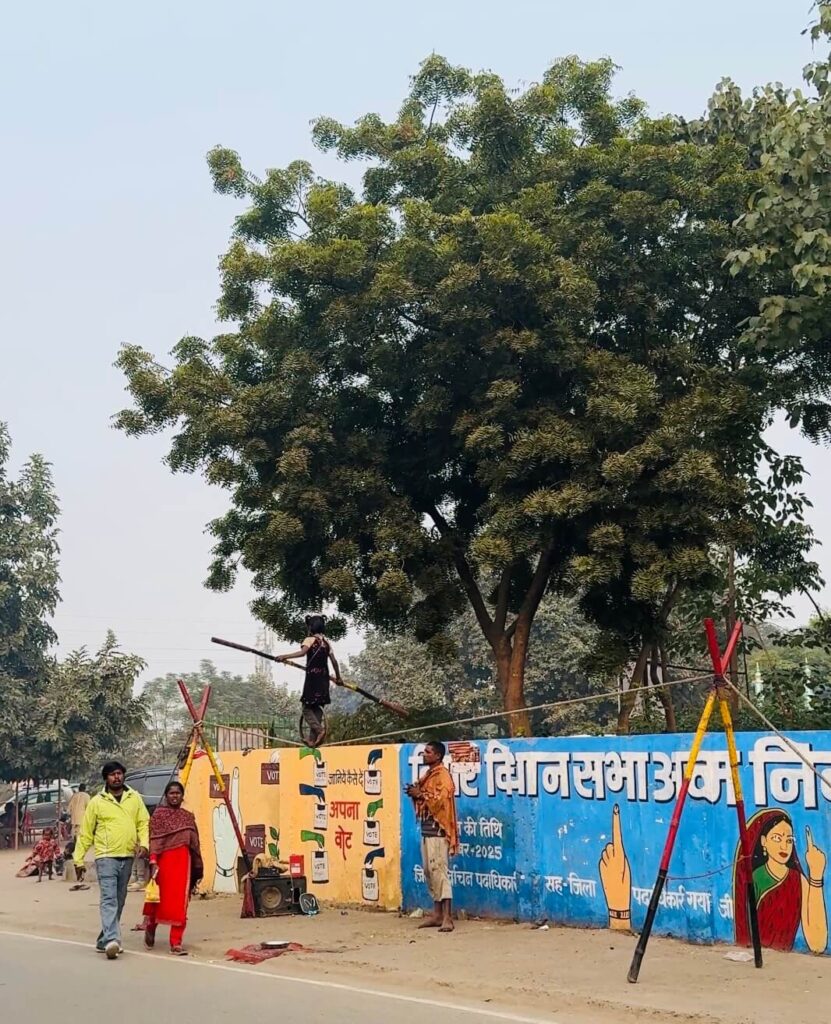
There is dirt, filth, chaos, and beggars everywhere. You can hardly see a person who isn’t begging. Children as young as two years old beg, dance, and run after people for money. If you happen to give 10 rupees to one, you will be enveloped by fifteen to twenty children, all asking for more.
There is a huge population among them because for them, more children mean more hands to beg and more money to bring home. It’s disheartening, but it is also the truth.
I wonder how we can ever uplift them and how we can ever change them?
Today, while we were having lunch at a restaurant, the owner there told us how she once offered one of such kids to become a helper and work at her restaurant.
The kid, in turn, replied: “I earn ₹1000-2000 a day begging- maybe even more than you..” and walked away, shutting the owner instead.
For many of them, begging has become easier than work and perhaps the only option they know. This is the reality of Bodhgaya outside the temple. Almost everywhere you turn, you encounter learned helplessness, filth, and chaos.
And though seeing large crowds is an everyday reality for me, the noise, the dirt, and the unpleasant sights felt overwhelming, especially during the first day of my visit.
And then there were flocks of them, both old and young, visiting the temple along with the hundreds of visitors from around the world.
But upon entering the Mahabodhi temple, something feels different. A sense of calm automatically softens my walking, my breathing, and my thoughts, and I immediately come back to my breathing and walking.
I sit under the Bodhi tree where the monks, nuns and lay believers are and in the calm, I notice my irritation, my prejudice, my unpleasant thoughts. Thoughts like: Their lives are not as important. Why are they here? Why do they have to come here for no reason? I even caught myself wondering why the Buddha had to gain enlightenment here and not somewhere else.
But then another part of me arises in stillness, and my thoughts gently move in another direction.
A quote I had once read came back to me hazily- something like – Anything that annoys you is teaching you patience. Anything that irritates you is your teacher.
I believe prejudice and irritation are so common in us, but we rarely recognise them.
It’s so easy to feel irritated. It’s so easy to get annoyed, but why does my peace have to depend on my surroundings?
Why should their lives matter less than mine?
No life is more or less important than another. Because we are alive, because we are born, we are equally worthy of being alive and respected as our birthright.
If my compassion and kindness only belong to the privileged, then it’s not true compassion.
And yet, there are many moments I still catch myself in prejudice and irritation. I haven’t overcome it. And it’s not easy.
But then I ask myself- what is easier?
If I cannot be more kind, more compassionate, more peaceful, then what can I be?
I think the answer lies in learning to be more tolerant.
Our peace in life is directly proportional to how tolerant we are.
I have seen people on flights who cannot stand even a few minutes without the air-conditioning turned on.
I have seen people get irritated simply because they have to fold clothes.
I say I don’t want to be like them, but what about my own impatience and intolerance?
I remember an incident from Darjeeling. My friend and I decided to go for a staycation at a small homestay.
In order to get there, we took a local taxi, but we didn’t know the exact location. We asked the driver to drop us at the last stop, which he did. After getting down, we realised we had no idea where to go. We kept calling the homestay owner, but he wasn’t answering.
Standing there with a backpack, feeling stranded, I was starting to lose my calm. When the owner finally picked up, he told us we had to walk a few more miles to reach the place. I immediately became irritated. Even though I was aware that I was being irritated, I didn’t want to stop it, and I kept fussing over the confusion and the minor inconvenience at least until midway.
I could have simply let go, practised tolerance, and walked the extra distance peacefully. But because I was less tolerant of discomfort and inconvenience, I became nagging and fussy.
Every day, we may get many moments where it’s easy to lose our calm and become irritated, but those are also exactly the moments that are opportunities to practice patience. Because how else would we?!
So this visit to Bodhgaya may not have been the most spiritual in the conventional sense. But it did offer me a small lesson to practice yet again, which I may have forgotten: to be more tolerant.
When I visited the temple again that evening, and again the next morning, I made a quiet decision: to be more tolerant, to see every irritation as an opportunity to practice patience.
And for this, I am not telling myself to be more patient, but to be more tolerant. Because tolerance is the starting point of patience.
This does not mean becoming tolerant of every wrong thing in life. But for the most part, I believe we are intolerant of so many small things. And if we and the world practised even a little more tolerance, there would be less hatred, less prejudice, and we would live much happier, more peaceful lives.
May we keep softening.
About other things:
Table of Contents
This next year, I want us to start a journey together. A journey where we slow down and practice living with presence, care and intention.
This had long been in my mind, and I think a new year would be a wonderful way to begin it.
I am naming this journey Rooted: A Practice in Being (A 100 Day Email Newsletter Series)
It will be an intentional space for those who are longing to pause and to be with what matters and stay rooted in oneself, one’s purpose, values and intention, away from urgency, noise, and the constant pressure to become something else.
Through heart-led letters, reflections, and simple practices, we will practice being with our lives rather than rushing through them.
This journey is not about fixing or improving yourself, but about noticing, softening, and learning and unlearning.
Starting 5th January 2026, I invite you to join me for Rooted: A Practice in Being—walking gently, imperfectly, and honestly.
This will be as much for me as it will be for you. And if you’ve been reading my newsletters for a while now and love them, you might love this too.
More on this and how you can join Rooted in my next newsletter.
Journal Prompt of the Week
- Where in my life am I being invited to practice patience rather than control?
- Where am I patient with others but impatient with myself?
Blog Post of the Week
Quote of the Week
One from Others
“It’s dark because you are trying too hard.
Lightly, child, lightly. Learn to do everything lightly.
Yes, feel lightly even though you’re feeling deeply.
Just lightly let things happen and lightly cope with them.
I was so preposterously serious in those days, such a humourless little prig.
Lightly, lightly – it’s the best advice ever given me.
So throw away your baggage and go forward.
There are quicksands all about you, sucking at your feet,
trying to suck you down into fear and self-pity and despair.
That’s why you must walk so lightly.
Lightly, my darling”
— Aldous Huxley, Island
One from me
The Universe is obedient. It gives us what we persistently ask for and work for.
Past Newsletters You Might Like:
- Expanding our Joy Span- Let Joy Stretch
- God Must Be An Audience
- On Travelling and Things that Travel Beyond Us
- Notes from Hills: On Change and Impermanence





Leave a Reply